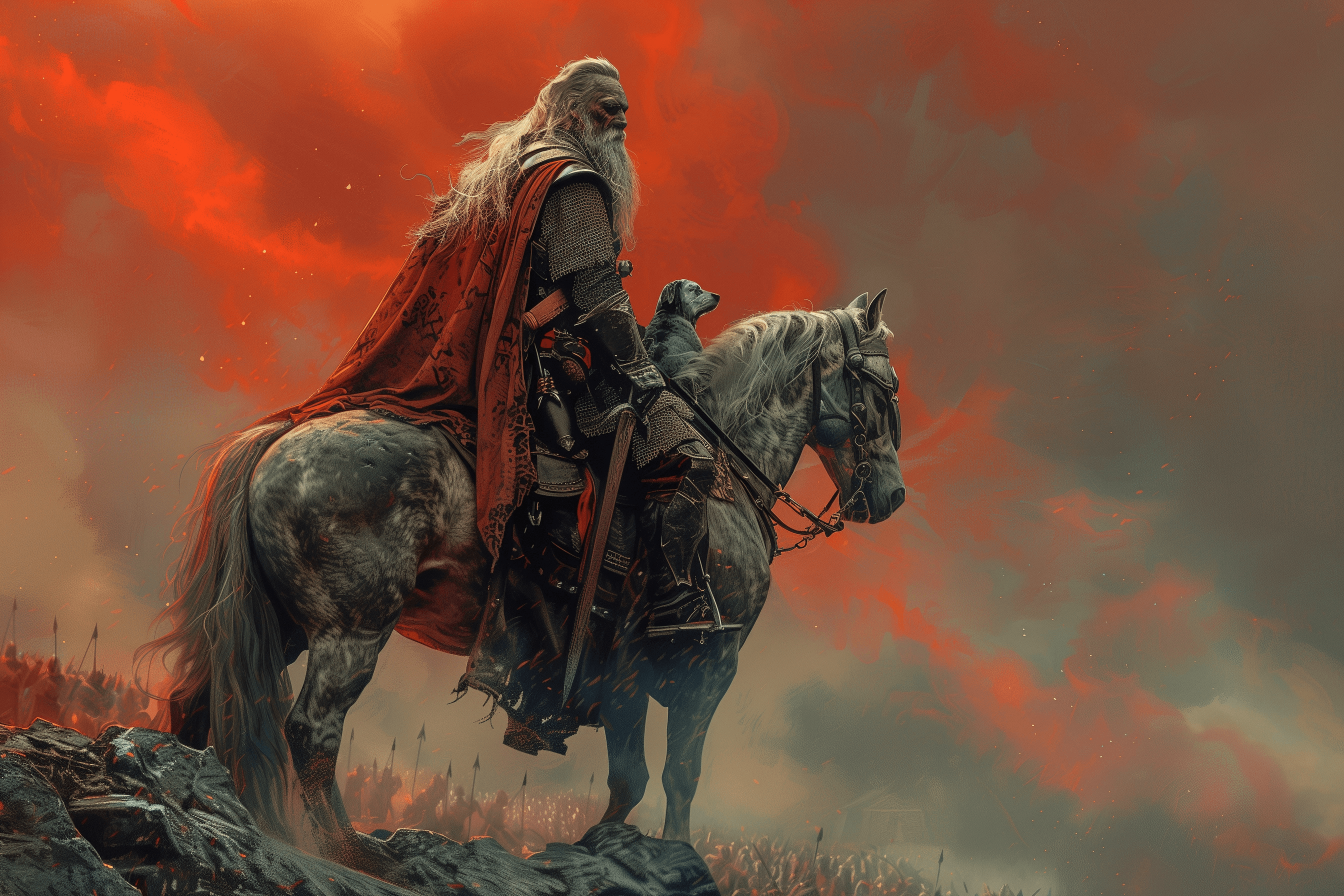
This poem was composed at an unknown date, by an unknown author, and primarily recounts the tale of Carol the Great defeating the Immortal King, Emrys, and binding him to his mountain tomb. It begins with an outline of Carol’s ancestry and some of their deeds, before moving on to the tale of “the Hunt-King.”
There are a few mistakes present in the poem: the composer emphasises that it is Carol’s blood which bound Emrys in the Edanian tomb, and although this may be true, it neglects to mention that the critical ingredient was in fact Emrys’s blood, which happened to flow through Carol’s veins. Emrys was an ancestor to Carol through the wife of Eomund, a descendent of Emrys. The composer either did not know this, or simply concealed it to emphasise Carol’s importance. The poem also suggests that Emrys’s defeat was immediately followed by peace. This is untrue, as soon afterwards, Ardonn and Aedonn warred against each other for over a decade. Nor did Aelda’s sons submit peacefully — only one did, and with Carol’s support in exchange for his fealty, he waged against his brothers for control over the remnants of Aedonn. It was only in 844, nineteen years after Emrys’s defeat, that peace came to the lands between the Cris and the Alps.
This is the version of the tale Matilda of Henton reads in one of the books found in Lord Adalbert’s library in Oldford.
~ Edward Godspeaker.
Lo!
Much we have heard of the mighty kings
and lords of the Eomunding line.
Songs have been sung of their glorious deeds
and tales told of their honour and luck.
From Adalwer, ancestor of twins,
who sired Eomund, and bold Eored
after stealing Sun’s-daughter from that silvery isle,
whose father was Cynric, that cunning foe
of the seas and the storms no other
dared brave. Born from Oswifa, wife of Godwer,
the first of that dynasty to don a crown.
‘Twas of Godwer the first of the songs were sung,
about his daring march to the dragon’s roost
on the hill of fire — Fyrdun it is called.
Alone went he, with hardened heart
and sharpened steel to slay the beast.
A great battle raged as the dragon roared
for nine long nights in that mountain’s bowels.
Alone fought Godwer against the fiend
till at last he triumphed over the tyrant Thorn.
He was made a king for his courageous deed,
and named Gehalgod — a holy name.
From Godwer’s grandson came those famous twins
who conquered the Crisans after Fyrdun blew.
Eored and Eomund of the Exiles came
to the land of the Ard and the Aed.
Twin rivers for twin kings,
their destiny none doubted.
Since Eomund the Exile many kings have ruled
from the throne of Ardonn, that mighty seat.
His grandson’s grandson was called Edwulf,
known for bringing the realm to ruin.
Infamous and impious was Edwulf the Spurned
for his war waged in Winterlow
he reaped God’s wrath.
Yet Adalwulf the Good-Healthed restored Ardonn’s might,
thus the Eomunding kings ended not their reign.
For generations they governed through peace and war,
then born was Edgar, Erila’s bane,
who halted the crossing of the Cris by our foes
from the south, the soft Erilans,
who despite their great empire, the envy of kings,
could not break the Ardish and Aedish united.
King Edgar sired Carol, that preordained son,
who when barely a man boldly wore Ardonn’s crown.
Queen Aelda the Cruel betrayed the young king,
but the armies of Aedonn were crushed and shamed.
Our victorious hero proved himself as High King,
yet the peace he had won would not persist,
for Emrys, the hunter, and his terrible horde
emerged to lay waste to the land once more.
Ancient he was, from an age long past,
cursed to endure an everlasting life
with unquenchable thirst, unyielding lust,
and insatiable hunger — he and his horde
immortality sorely suffered,
a wicked mockery of what all men desire.
And so, enraged, Emrys ravaged our land.
His spite was unholy, his fury unceasing.
As the Grey Wolf waged war
Ardonn burned and bled. Bloodshed he sought,
and the shattering of shields.
The country was harrowed by those horrible hooves,
and folk feared their doom had awoken at last.
Caught off guard was Carol that year
when the Hunt-King returned for revenge.
None could withstand his heartless host
as one by one forts fell to his wrath.
Carol sat helpless behind high walls
knowing not how to best that cruel conqueror.
He sought wisdom from the wisest of men.
They told him to go with the Gods at his side,
to march for the madness being wrought.
Even his Godwin, a peaceful Godspeaker,
agreed with that sage advice.
And so went forth the fate-bound king
to face the fearsome horde.
With three thousand men
and three hundred horse,
the armies of Ardonn marched.
Their spears and swords gleamed bright in the sun,
their axes were sharp, their arrows fierce,
their hammers as hard as their hearts.
Shown on their shields was the dragon of Ardonn
just as it flew on banners of black,
golden and glorious as the morning sun.
The royal worm waved in the wind
flying over fields, forests, and hills
heralding the Hunt-King’s doom.
Then came Aelda, Carol’s old foe, as a friend
with soldiers and silver she pledged support
and swore to spill blood at Ardonn’s side
in return for her son, whom Carol held hostage.
The other kings watched as the Twin Kingdoms marched,
hiding away in their halls from the horde.
Only the heir to the Eomunding name, and the Eoreding queen,
had bravery enough to ride for battle.
They met Emrys in war that mournful spring
in the country by the coast.
The fyrd made its stand in a field
nine miles north of the Everlynn woods.
The shield wall stood strong
and firm ‘gainst their foe.
With howls and wails the horde did charge,
their swords and spears held aloft,
their war-beasts whinnying, snorting,
moving like demons through the morning mist.
The bravery of Ardish men was spent, their spirits broken,
at the sound of the doom-criers’ din.
Bows were bent and arrows flew,
but naught it was for, for none could withstand
the storm that struck the Ardish line.
They burst through the centre and broke the wall,
panic ensued as the men sensed their peril,
and the fearful warriors fled for their lives.
Those that could run ran for the hills;
those that could not were cut down.
Their bodies were broken, their blood stained the fields,
and their bones bleached the soil for decades to come.
Aelda of Aedonn arranged a retreat
and Carol went with her with what men he had left,
without Godwin; the Godspeaker was lost.
They fled for the sea defeated, forlorn,
where they boarded their boats on the beach
in vain, for vicious immortals were close behind.
Some ships left the shore, with both king and queen,
while fall did those with less fortune
as they drowned or made red the brine with their blood.
For Ardonn’s capital then sailed the survivors
and Carol, shamed, secluded himself in his hall.
For months they waited while the Wolf waged war
against Ardonn’s lords, abandoned by their liege.
Then Godwin Godspeaker at last returned,
though spoke little of where he went.
Rumours were spread that he’d left the realm
of the living, to learn the secrets
of the Immortal King’s curse.
Then fast he departed with a few trusted men
and Carol the king by his side.
While Aelda went south to the Aed River’s ford
and Aleanor, Carol’s Queen, sat on Ardonn’s throne
and ruled as regent while her husband was gone.
Carol hastened for a hidden place
high in the hills and mountains in the north,
and for two troubled years the king was away
in the hallowed halls of the ancients
deep beneath a peak where giants built
a crypt for their kings
who long ago ruled over these lands
for centuries unageing, undying,
till the Thorns took their thrones.
Carol knew he could not defeat the Hunt-King
in battle, so a bold deception he conceived.
Godwin rode south to find the Grey Rider
and present him with Carol’s offer of peace.
In return for a halt to the horrors he wrought
the Godspeaker would grant him release
from his curse. Carol waited while Emrys
rode with his whole retinue north
desperate for an end to that endless war.
With false promise they lured him, and led him
down deep, ‘neath the mountain where darkness did reign.
Proud Emrys took the bait, perhaps eager
for the suffering he and his men bore to cease.
Trust Godwin the trickster the immortal king did
and so willingly went he into that tomb
with all of his men, driven to their doom.
Emrys did hope for an end to his curse
but once within the crypt
they were sealed away by a spell
woven by the wise Godspeaker
who with his sword spilt Carol’s blood
(a drop — no less, no more)
which was willingly given by the king,
for not any blood would do, but the blood of the mighty
which from Godwer Gehalgod, the greatest of kings,
flowed through man after man
for six centuries, hallowed
by great deeds and the Gods, who gave
life to that line through Lita, the daughter
of the soaring sun.
‘Twas the blood of Edgar, Edmund, Edwulf and Edwin,
Cedwulf and Cerdring
and Adalric the Artist,
Emming and Edward, and Edbert the Strong
Effing and Edwise, Edric, Edhelm,
Bedwin and Baldwin,
Clodwig and Clodild the Queen of the Ard
who crushed the revolt of the Crisan slaves,
and all other kings and queens who came
before Carol the King, Carol the Great,
who from Eomund the Elfmade
he did descend.
The sepulchre was sealed
with Alcyn’s aid
and with Carol’s blood and a barrier raised
to ward the World against Emrys
and his horrible horde.
Carol then returned to his kingdom triumphant
and forged an era of enduring peace.
He was hailed as the hero of all the lands
‘twixt the Cris and the Alps, of the Ard and Aed.
Submit did the sons of Aelda the Cruel
and swear fealty did the free lords and earls
of the shires and shores.
United again after six centuries were the kingdoms
of the Exiles, of Eored and Eomund.
All now answered to the King of Ardonn.
One realm, one ruler, one destiny,
secured by Carol who sealed away the Hunt-King.
For seven decades he sat on that throne
then passed in his eighty-eighth winter.
To his second-born son went his kingdom united.
Francis the First was his name, and fairly he ruled.
No wars he waged within or without
while sovereign, nor did his son,
thus for three generations the Gods granted us peace
until Hemma’s bold betrayal.
But persist in his prison,
did the Wolf while he waited
for the time when prophecy told
of the coming of the king
who terror one last time would bring;
the Harbinger of Havoc,
the Horseman’s Horde,
the Envoy of the End of Days,
and the paver of paths for the Thorns.
 Jason Malone
Leave a comment