The religion of Ardonn is by no means uniform. In fact, it has been said that there is no single, true “religion of Ardonn” but that instead there are numerous religions of Ardonn. Even if we are to ignore the division between the “Old Ways” and what we call the “King’s Way” (that is, the public religion of the King of Ardonn, the seat of which is the Capital’s Grand Temple; the head of which is Ardonn’s Highest Priest, and the king de jure), there still exist many regional beliefs, practices, and cults, reflecting the diversity of Ardonn’s varying cultures, dialects, and lifestyles.
Among these various regional religions is Winterhome’s cult of the Flame of Kings, or simply, the King’s Cult. The word “cult” may be misleading to those not hailing from Winterhome and its shires, for what we refer to here is not so much a distinct sect as it is simply the term for a unique, additional set of beliefs and practices woven into the official royal doctrine.
The cult’s origins are little known aside from the fact that it emerged among the lower nobility of the Shires of Winterhome before swiftly being adopted by common folk and Winterhome’s high nobility, sometime immediately following the settlement of the Exiles in the area. It is however no surprise that a doctrine centred around the king should emerge in the far north — an area with a strong tradition of sacral regality, even before the migrations of our people.
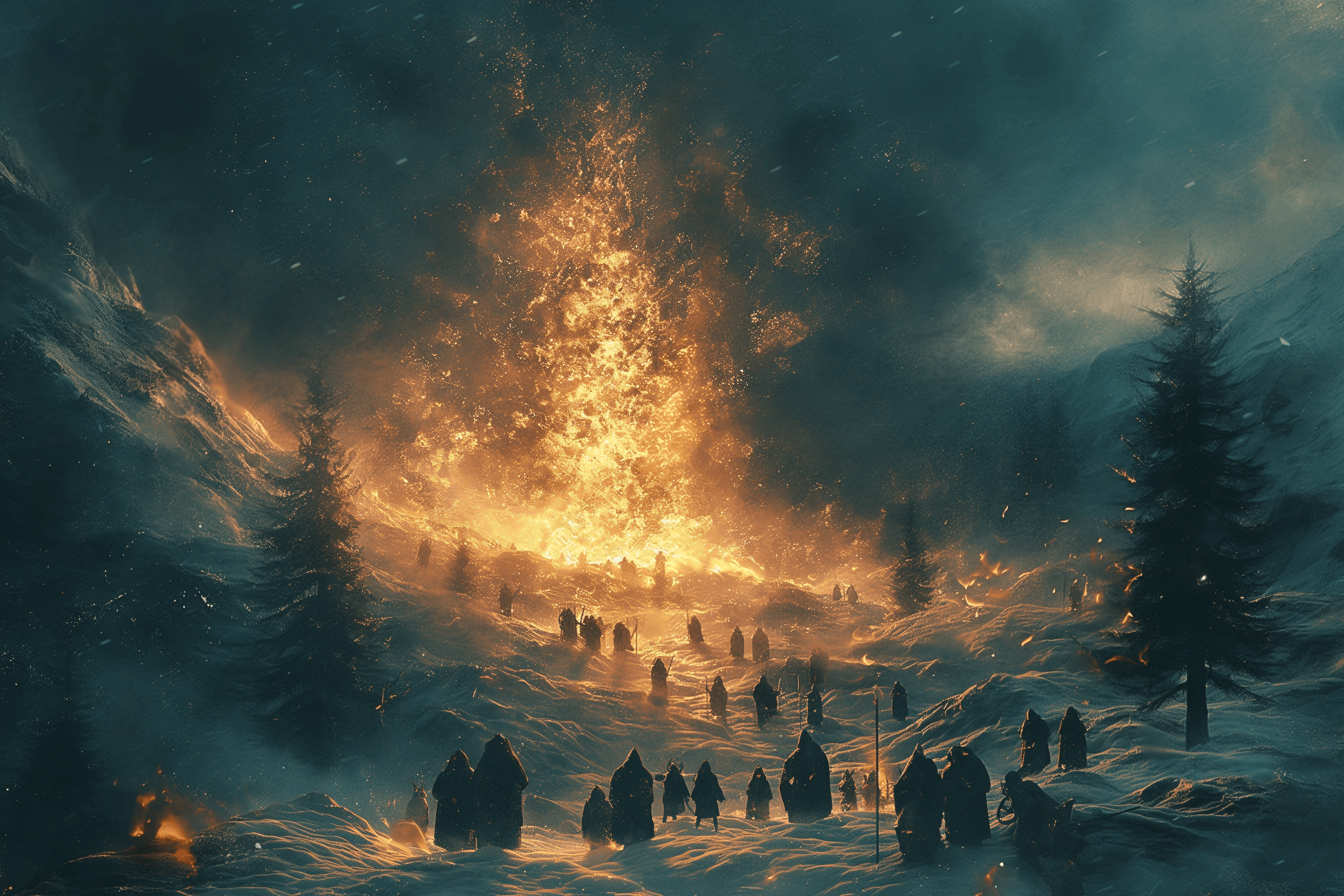
You might be wondering: what exactly is the Flame of Kings? According to legend (and cult orthodoxy), when Eomund the Exile went north to conquer the Crisans of Winterhome his army was caught in a severe, unexpected blizzard. The storm forced the army to halt, but shelter they could not find, nor did the weather allow them to light a fire. They had no choice but to endure the bitter winds, exposed, but without the heat of a fire they would surely have succumbed to the cold.
As the story goes, King Eomund prayed for respite from the storm. His pleas went unanswered by the Gods until eventually his niece, a brave shieldmaiden of only fifteen winters, offered herself as a sacrifice. Eomund tried to stop her but she would not listen. Falling on her own sword, Bladswith died nobly, and it is said her spirit hastened to the Halls of the Gods and begged them to aid her uncle.
They did so, admiring Bladswith’s sacrifice. Where her body lay there grew suddenly a mighty pine, which was subsequently struck by a bolt of holy lightning and burst into flames. The fire engulfed the tree, and the Exiles crowded around it to be embraced by its warmth, praising the Gods and the King’s nephew. They were saved, for the tree fought off the cold until the blizzard had passed and Eomund’s army could resume its march.
Legend tells that as the tree turned to ash and the fire burned only the stump, Eomund had a temple built around what remained and ordered that the flame be tended till the end of days, so that the life of his niece — and thus the luck and divine right of he and all his heirs — never run out.
This was done, and so now the people of the Shires of Winterhome revere what became known as the Flame of Kings and continue to uphold Eomund’s wishes that it never die. So that the Flame may never be untended, a unique order of priestesses was founded in Bladswith’s name: the Firemaidens. The Firemaidens forsake worldly existence in favour of a life devoted to the Temple of the Flame, rejecting any titles, wealth, lands, or bonds not associated with the Temple.
None know of the location of the original Flame of Kings. There are now in fact five Flames in existence, each with their own Temple and order of priestesses, and each temple will claim their fire to be the source of the other four, and thus the true resting place of Bladswith (though there are perhaps hundreds of temples around the Shires with their own Flame, but these admit to being sourced from an original). Nevertheless, all five temples are considered holy sites by the cult’s adherents, and regular pilgrimages are made to each of them.
Of all the Flames, that which burns at Kingshowe is perhaps the most interesting case, and which I believe has the strongest claim to originality. The other four flames all burn in temples located in cities and towns which are known to have existed before Eomund’s conquests, so their claims are inconsistent with official orthodoxy. Even the Lord of Winterhome recognises the Kingshowe Flame to be the source despite the temple in that city also boasting a Flame of its own.
No known settlement existed in Kingshowe before its Temple appeared. The Temple and its surrounding town were built at the foot of a great hill, which locals believe to be the barrow of a legendary king. It is not known whether the hill existed before or after Eomund’s arrival, nor is it known who is supposedly buried there. Some have said the howe is the resting place of Carol the Great; others have claimed it is Eomund himself buried there, desiring to be close to his niece in death (though this cannot be true, as royal doctrine states Eomund is buried along the bank of the Ard). A few have said that the grave belongs to a king living long before even the Third Age of Man, perhaps even living during the time of the Edan. Whatever the case may be, it is clear that the hill at Kingshowe is important to its people, and stories about it have been interwoven with the cult’s official doctrine.
The cult at Kingshowe is especially interesting precisely because of this hill and the legends surrounding it. According to the High Priest, the king buried beneath the hill (whose identity he refuses to speculate on, in his humility) is not actually dead, but is merely asleep, his body preserved by divine grace. It is said that one day, in the not too distant future when Ardonn is on the brink of collapse and the world almost swallowed by darkness, that king shall wake and usher in a new age, driving the darkness from the land.
Atop the hill at Kingshowe sits a lone apple tree, its branches bare. This unusual tree is named by locals “the Blossoming Tree.” The tree appears dead but the High Priest insists that it is only asleep like the king beneath it, and that shortly before the king rises from his grave, the tree will blossom for the first time to herald his coming.
To ensure the tree remains alive, the young priestesses at Kingshowe long ago adopted an additional duty on top of their responsibilities to the Flame. Each day one of the priestesses must climb up the hill to the tree and perform a special rite to sustain it. None but the priestesses may carry the vessels which contain the tree’s offerings — even the High Priest cannot touch them. The hill itself is considered sacred, and those who set foot upon it at night are flogged and hanged, though the enforcing of this law has been neglected in recent decades.
To the people of Kingshowe the Blossoming Tree has become just as important as the Flame, if not more so. So important is the hill to local lore that the Firemaidens of Kingshowe have adopted a new name for their order: the Barrowmaidens.
I suspect that the expansion of the Firemaidens’ duties is tied in deeply with their cult’s doctrine. The priestesses tend to a fire that embodies the fortune of the reigning monarch, so it is only natural that they also assume responsibility for tending to the tree associated with the return of true kingship to Ardonn.
It cannot be determined how much truth there is to the legends of the Barrowmaidens or the rest cult of the Flame of Kings, but it must be said that stories of a king buried beneath a hill or mountain who shall one day return to cleanse or restore the land are not unique to the Shires of Winterhome.
It is said that if the Flame of Kings were to die, Ardonn would soon follow. It may all be superstitious nonsense, but just in case the people of Winterhome are right about their fire, I suppose it could not hurt to allow this cult to survive. The Kings of Ardonn have been lucky enough thus far.
May that luck never run out.
 Jason Malone
Leave a comment